Colorado Wildlands Fire Conference 2026 Important Information
As we get ready for fire season this year, we thought we would send an immediate newsletter after attending the Fire Adapted Colorado Wildlands Fire Conference last week. The key takeaway message is:
"Wildfire is inevitable (and ecologic). Home destruction does not have to be."Jack Cohen, PhD Fire Science
Nature is going to take its course. Drought, Too Many Trees, and Pine Beetles lead to wildfires. Extensive research demonstrates that the problem is NOT the wildfire. The problem is ignition and destruction of homes. It is the home's vulnerability to hot embers and intense heat that ignite a home. Home destruction can be prevented by aggressive management of the Home Ignition Zone, defined as 0-100 feet around your home. The recommended steps are to start with your ignition zone (0-5 feet), working your way outward into the intermediate zone (5-30 feet) and the extended zone (30-100 feet.) If your home is within approximately 100 feet of your neighbor, your zones may overlap and create shared risk. (We are not using numbers to describe these zones in this newsletter. Labeling the zones within the industry is continuing to change while the zone definitions remain constant. Refer to each zone by the size/distance from your home, not by the zone number when reviewing any reference you see.)
Dr. Jack Cohen is the pioneer of the home ignition zone concept, and he was at the Conference to help us understand the science behind each zone. "Ignition" refers to three conditions for things to ignite. If we remove any one of those conditions (one side of the ignition triangle below), ignition will not occur. We can control both fuels (our ignition zone, 0-5 feet) and heat intensity (our intermediate 5-30 feet and extended 30-100 feet zones,) but we cannot control the oxygen present in the air.
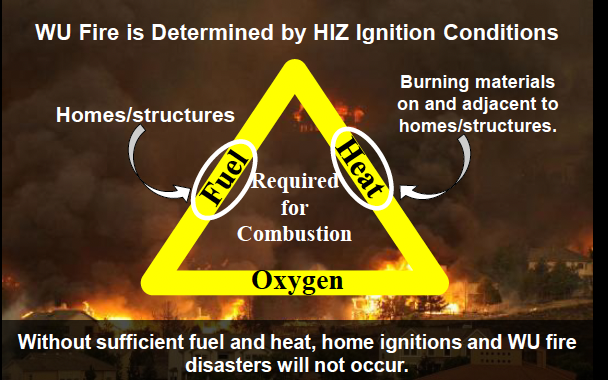
Caring for your ignition (0-5 foot) zone removes the fuel sources that are required for ignition. And "if a home does not ignite, it will not burn." (Jack Cohen, PhD). Areas where pine needs or leaves accumulate are areas that embers may accumulate. Maintaining those areas as well as limiting access by embers through vents of any kind using a maximum 1/8 inch screening material helps to reduce your exposure.
Your ignition (0-5 feet) is the critical step. In other words, if you don't take care of your ignition zone all season, none of the rest matter.Your Friends at WBMD
Managing the vegetation in your intermediate zone (5-30 feet) reduces ignition risk by increasing exposure time and reducing intensity of heat needed to ignite any fuels that may be present in the ignition zone (0-5 feet.) Consider limbing your trees to 6-10 feet but NO more than 1/3 the height of the tree; and mowing grass to more than 4 inches.
Managing your extended zone (30-100 feet) lowers intensity of heat to the intermediate zone, which then presents less intensity of heat to your ignition zone. Things to consider in the extended zone are clumping and thinning of your trees. You will find a great infographic on tree spacing in the Firewise (TM) checklist and great information on thinning/clumping trees for many tree species in the Colorado State Forest Service checklist. These checklists are under our "Home Hardening" tab to the right.
Hannah Ohlson from Summit Fire and EMS also did a great demonstration showing how tree clumping works to slow down or stop fire spread up hills (under our "clumping" tab to the right.)
There are many photos that can be found of the 'miracle house' that was spared after an urban conflagration event. The common theme to these homes is the ignition zone (0-5 feet) was managed. Homes that survived the most heat (crown fire or grass/shrub fire) had lower heat intensity exposure from their outer zones (5-30 feet and 30-100 feet.)
Dr. Cohen emphasized that homes are burning the trees - NOT the other way around. Live standing trees around completely burned homes is a normal finding post wildfire. He also points out that many times the homes ignite without direct contact to a wildfire or have ignited after the wildfire has passed through. An ignited home can produce hot embers that land on neighboring homes - and if those neighboring homes ignite, they may spread their embers. A wildfire (whether in the forest or from a grass/shrub fire) does not require direct contact with homes to spread to homes; and homes do not require wildfire to ignite!
We have a link to our "Home Hardening/Home Ignition Zone" Page. On this page, you will find Home Ignition Zone Checklists from Firewise, Colorado State Forest Service, and Wildfire Prepared Homes. (The Wildfire Prepared Homes Checklist from teh Insurance Institute for Business and Home Safety, IBHS, is very detailed.). The Wildfire Prepared Homes Certification Program is also in the works for Colorado - another great reason to follow the Wildfire Prepared Homes checklist: Insurance!
Hannah Ohlson, our Summit Fire and EMS Community Officer, has time now to do free home ignition zone walk throughs. Connect with her before she gets busy! You will find a link to her contact page on the right.
Let's do it! Remove fuels (ignition zone) and reduce the heat (the outer zones!)